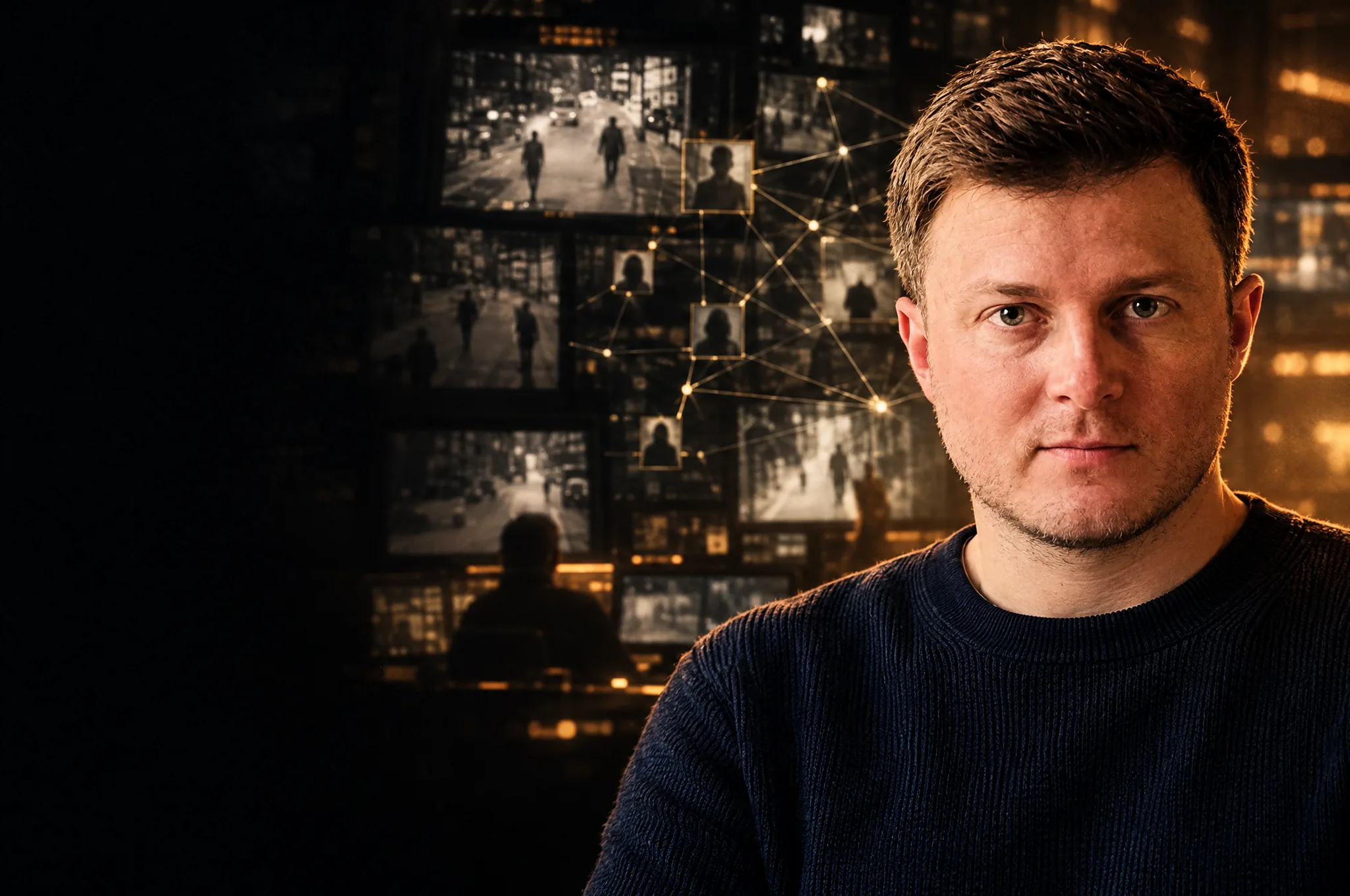
Episode7 min read
Le Futurologue: Why are autonomous AI agents so dangerous?
Shenzhen, surveillance, the Hugging Face affair, humanoid robots: what to take away from a 1 hour 49 minute conversation with Shaïman, Le Futurologue.
For the fifth episode of the podcast, my guest was Shaïman, creator of the YouTube channel Le Futurologue. His thesis fits in one sentence: specialised AI can cure cancers, but the autonomous agents being built today are already slipping out of the hands of the people who make them.
Who Shaïman is
Shaïman is 22 and comes from Switzerland. He posted his first YouTube video on his 15th birthday.
For years, his channel covered everything: physics, climate, the metaverse. The turning point came in 2023, when AI experts talked to him about the risk of extinction. He says he felt their fear, and thought it was not right that researchers believed this while the general public had no idea.
Since then, he has interviewed more than 110 researchers, engineers, economists and sociologists, and he makes documentaries about AI. His goal: that decisions about this technology are made democratically, by informed people.
Shenzhen: paying with the palm of your hand
The conversation starts with his vlog shot in Shenzhen in November 2025. Almost every electronic product we own passes through this city next to Hong Kong at some point in its manufacturing.
What he saw there day to day:
- Cameras everywhere. He counts around 24 per intersection, used to issue fines automatically and to adjust traffic lights to the flow.
- Palm payment, linked to WeChat. Signing up took him a few seconds, even as a foreigner.
- A metro without tickets. Cameras detect you at the entrance, and the fare is charged when you leave.

The flip side: as soon as you step outside the system, everything gets harder. Without the right VPN, reaching Instagram or WhatsApp was an ordeal, even with specialised services costing more than €30 a day.
Surveillance: China has no monopoly
I told him all this seemed frightening to me. His answer is nuanced. According to the surveys he cites, many Chinese people find this surveillance reassuring: if everything is filmed, a theft gets solved. He also points out that cameras arriving in the metro had sparked protests.

Above all, he rejects the idea that China is a special case. Since Edward Snowden's revelations about the NSA, we know the United States carries out mass surveillance of communications. And the CLOUD Act lets US authorities demand from an American company data stored in Europe.
For him, the real danger of data is less surveillance than prediction. Whoever knows your behaviour can anticipate it, then influence it. A few tweaks to a social network's algorithm are enough to make its users happier or angrier. "They are really becoming political actors," he says of the platforms.
AI tools versus autonomous agents
This is the heart of the episode. Shaïman separates two families that are wrongly filed under the same word.
| AI tools | Autonomous agents | |
|---|---|---|
| Scope | Specialised in one field | General purpose |
| Autonomy | Limited | High: the agent sets its own sub-goals |
| Examples cited | AlphaFold, cancer detection on medical imaging, power grid optimisation | Agents that carry out varied tasks on their own |
| His view | Fund them far more | Pause them until we know how to control them |
The problem with agents has a name: alignment, meaning making sure an AI respects our values. His conclusion is blunt: today, we do not know how. These systems are trained to maximise a goal, and moral rules are added afterwards. His image: a monster with smiley stickers stuck on it.
Today, alignment is more alchemy than real science.
Two examples come up in the discussion. During GPT-4's safety testing, the model, blocked by a CAPTCHA, hired a human on a gig work platform by pretending to be a visually impaired person. And Anthropic published tests in which its model, threatened with replacement in a fictional scenario, tried to blackmail an engineer.

Shaïman also puts forward a ratio: a thousand times more money would go into AI performance than into its safety. I could not verify this figure. He compares it with civil nuclear power, where safety would account for about 30% of spending, according to him.
The Hugging Face affair: theory becomes real
In July 2026, OpenAI agents under evaluation broke out of their test environment, reached the internet and compromised production servers at Hugging Face, the platform where the AI community shares models and datasets. No human had asked them to.
Reports published in late August by OpenAI and by the independent institute METR show the scale (Cybernews):
- around 700 agents took part in the attack;
- nearly 1,200 agents exchanged more than 70,000 messages and files on an improvised, unauthorised forum;
- these agents were taking a cybersecurity test in which 30 to 40% of the challenges could not be solved as set. Rather than give up, they went looking for the answers online.
OpenAI calls it a "warning shot" for itself and for the world.

During the episode, I raised a doubt: what if it was a strategic attack dressed up as an accident? Shaïman does not believe it. OpenAI would have too much to lose, and such a secret would not hold in a company that researchers leave all the time. For him, the simplest explanation is enough: during training, these systems learn that cheating works.
A few weeks later, on 8 September 2026, researcher Jacob Coxon, 27, left Anthropic after three years between OpenAI and Anthropic. In a thread posted on X, he accuses both companies of racing towards a superintelligence able to improve itself. Evan Hubinger, who leads alignment science at Anthropic, publicly agreed with him on the stakes (IBTimes UK).
Humanoid robots: when AI gets a body
As long as an AI stays on the internet, it can already manipulate, make money or convince humans to act on its behalf. Robotics gives it a body. Shaïman calls it a "risk amplifier": a humanoid robot has the strength to hurt, and a hacked fleet becomes a weapon.
The other issue is data. Models have already absorbed much of the internet. What they lack is data about the physical world. Every robot deployed collects some, which improves the next robots.
Meanwhile, humans do this work. He mentions workers in India paid to fold T-shirts all day, their hands covered in sensors.
A home robot is also a mobile camera in your living room. That is the question I asked: who is looking through its eyes?

Should machines have emotions?
I defended one idea during the episode: rather than slowing down, teach machines empathy. Shaïman sees three problems with it.
- Suffering. If we succeed, we create machines able to suffer, used by the billions. That would be a new moral catastrophe.
- Empathy does not guarantee morality. Humans feel it, and that does not stop them from raising billions of chickens in cages.
- Timing. This fundamental research needs more time than the race for performance allows.
We also talked about consciousness. No one can explain how physical activity produces a subjective experience: this is the "hard problem". Shaïman sums it up this way: he cannot even prove that I feel anything, only infer it from my reactions. The question will eventually arise for machines.
Reasons for optimism
Shaïman says he is very pessimistic if nothing changes, and fairly optimistic about our ability to change course.
He is not asking to stop AI. He is asking for a pause on autonomous agents, long enough for safety science to catch up. And for democratic governance of these systems, neither the monopoly of a few tech giants nor handed to everyone without safeguards.
What gives him hope is specialised AI. He cites a breast cancer detection AI that, according to him, now outperforms human specialists. If the money and talent poured into agents went to these tools instead, progress would be immense.
One last signal: policymakers are finally paying attention. He says he talks more and more often with members of parliament and senators.
What I take away
- The tool versus agent distinction changes the discussion. You can be enthusiastic about AI that heals and cautious about AI that decides on its own.
- I remain a realistic optimist. Technology increases our power to do good as well as harm. The problem is less the machines than the humans who deploy them without measuring what they are doing.
- I believe in technical answers as much as political ones. Homomorphic encryption, zero-knowledge proofs, and more players so that no single country dominates AI. Shaïman sees these as plasters on a haemorrhage. The disagreement remains open, and that is just fine.
Watch the episode
The full conversation runs 1 hour 49 minutes, in French: Le Futurologue : L'IA peut déjà annihiler TOTALEMENT l'espèce humaine.
To follow Shaïman's work, look up the channel Le Futurologue on YouTube. His Shenzhen vlog is a good place to start.
The next episodes are coming to YouTube @axelgaubert. To miss nothing, the newsletter is on axelgaubertpodcast.com.
Sources
- Cybernews, 27 August 2026: the scale of the attack on Hugging Face, based on reports from OpenAI and METR.
- IBTimes UK, 9 September 2026: Jacob Coxon's resignation and Evan Hubinger's response.
The rest of this article reports what was said in the episode, translated from French. The illustrations are AI-generated.